
2026 Best Carbon Steel Pipe for Sale Global Buyers Guide
The 2026 global market offers many options for buyers seeking carbon steel pipe for sale. These pipes support water systems, structural frames, energy projects, and industrial fabrication. However, the lowest quoted price rarely tells the whole story.
Pipe selection should begin with service conditions. Buyers need to confirm outside diameter, wall thickness, length, grade, and connection type. Application temperature matters too. A pipe for a buried water line faces different risks than one carrying hot process fluids. Relevant standards may include ASTM, ASME, EN, API, or national specifications. Always match the standard to the project.
Small details matter.
Experienced suppliers should provide mill test certificates, chemical composition, mechanical results, and heat numbers. Independent inspection can verify dimensions, surface condition, marking, packing, and quantity before shipment. Photographs of bundled pipes, painted ends, and moisture protection offer useful evidence. Still, documents can contain errors. One overlooked unit conversion may affect an entire order.
A reliable buying process also examines production capacity, export experience, lead time, payment terms, and after-sales support. Carbon steel can rust during ocean transport without suitable wrapping and storage. Buyers should request coating details, packaging photographs, and clear delivery responsibilities. This guide compares common grades, sizes, manufacturing methods, quality checks, and supplier questions for 2026 purchasing decisions. It cannot replace an engineer’s review of the final design, and that limitation deserves attention. Good sourcing is not only about finding pipe. It is about reducing uncertainty before the first bundle leaves the mill.
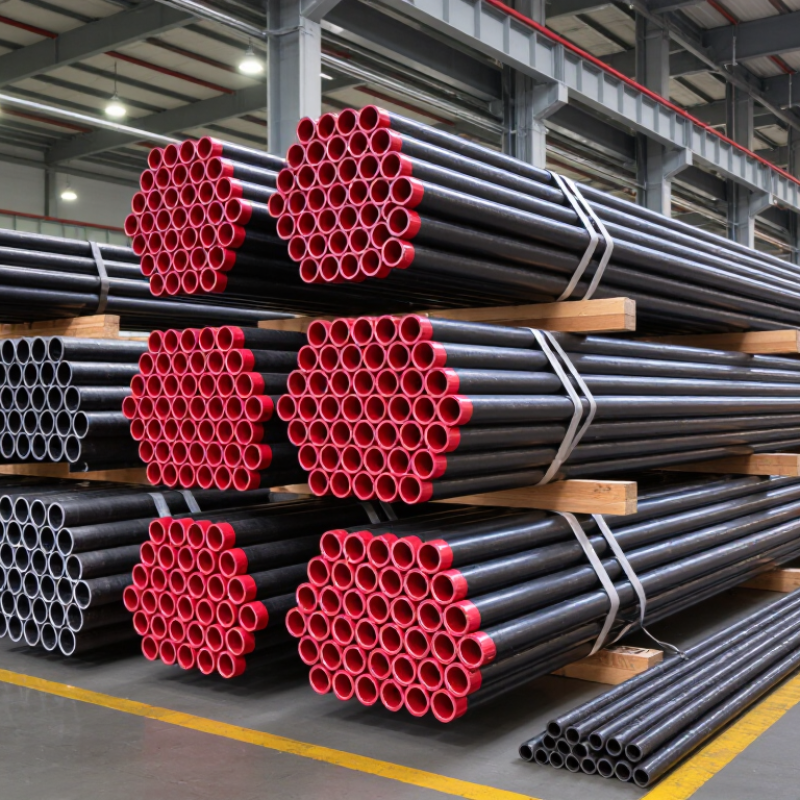
Carbon Steel Pipe Basics: Grades, Types, Sizes, and Common Uses
Carbon steel pipe is made mainly from iron and carbon, with limited alloying elements. Its strength, weldability, and cost make it common in construction, water systems, process plants, and structural work. Grade selection matters. ASTM A53 Grade B suits general mechanical and pressure applications, while ASTM A106 Grade B is designed for high-temperature service. Line-pipe grades such as X42 and X52 are often selected for fluid transportation. These grades are not interchangeable without checking the design standard.
Pipe types also affect performance. Seamless pipe has no longitudinal weld and is often used for demanding pressure or temperature conditions. Electric-resistance-welded pipe offers consistent dimensions and efficient production for many industrial systems. Spiral-welded pipe can serve large-diameter water or infrastructure projects. Each type has trade-offs. Fit comes first.
Sizes require more than checking the outside diameter. Nominal pipe size, wall thickness, schedule, length, and end finish must match the drawings and connection method. A thicker wall can improve pressure resistance, but it also adds weight and may complicate welding. Common uses include boiler lines, fire-water systems, oil and gas service, scaffolding, and building columns. I still recheck mill certificates, dimensions, surface condition, and test requirements before purchase. A catalog description can be incomplete. One overlooked detail may delay installation.
| Category | Item or Grade | Typical Specification or Data | Common Size Range | Typical Uses | Selection Notes |
|---|---|---|---|---|---|
| Carbon Steel Pipe Fundamentals | |||||
| Material Definition | Carbon steel pipe | Iron-based pipe in which carbon is the principal alloying element. Manganese, silicon, sulfur, phosphorus, and residual alloying elements are controlled by the applicable standard. | Small-bore to large-diameter pipe, depending on the manufacturing method and standard. | Fluid transport, pressure service, structural work, utilities, and industrial systems. | Carbon steel is generally economical and strong, but it normally requires corrosion protection when exposed to moisture, chemicals, or aggressive soil. |
| Pipe versus Tube | Pipe | Usually identified by nominal pipe size (NPS) and schedule, with dimensions commonly governed by ASME B36.10M for welded and seamless wrought steel pipe. | NPS sizes such as 1/2, 1, 2, 4, 6, 8, 12, 24, and larger. | Process piping, water lines, steam lines, and transmission systems. | Pipe dimensions are selected by nominal size and wall thickness; actual outside diameter remains fixed for a given NPS. |
| Common Carbon Steel Pipe Grades and Standards | |||||
| ASTM A53 Grade B | Welded or seamless pipe | Minimum yield strength: approximately 240 MPa. Minimum tensile strength: approximately 415 MPa. | Commonly supplied from small diameters through large structural and utility sizes, subject to product form. | Water, air, steam, low-pressure process service, fire protection, and general mechanical applications. | A versatile general-purpose grade. Confirm whether Type E, Type S, or Type F construction is required. |
| ASTM A106 Grade B | Seamless high-temperature pipe | Minimum yield strength: approximately 240 MPa. Minimum tensile strength: approximately 415 MPa. | Commonly used in nominal sizes from 1/8 through 26, with availability depending on the supplier and specification. | High-temperature service, steam, refinery piping, boiler connections, and process lines. | Designed for elevated-temperature service. The complete design must consider temperature, pressure, corrosion allowance, and allowable stress. |
| API 5L Grade B | Line pipe, PSL 1 or PSL 2 as specified | Typical PSL 1 minimum yield strength: approximately 245 MPa. Minimum tensile strength: approximately 415 MPa. | Small, medium, and large diameters for pipeline construction. | Oil, gas, water, and other liquid or gaseous transmission pipelines. | Specify product specification level, delivery condition, testing, ends, and impact requirements according to the pipeline project. |
| API 5L X42 | High-strength line pipe | Minimum yield strength: approximately 290 MPa. Minimum tensile strength: approximately 415 MPa. | Available in welded and seamless forms depending on diameter, wall thickness, and purchase specification. | Pipeline transportation of oil, gas, and water. | Higher strength than Grade B can support reduced wall thickness or higher design efficiency, subject to engineering approval. |
| API 5L X52 | High-strength line pipe | Minimum yield strength: approximately 360 MPa. Minimum tensile strength: approximately 460 MPa. | Frequently selected for medium- and large-diameter transmission lines. | Long-distance oil and gas pipelines, water transmission, and industrial utility pipelines. | Weldability, toughness, sour-service requirements, and fracture-control requirements must be checked for the project. |
| API 5L X65 | Higher-strength line pipe | Minimum yield strength: approximately 450 MPa. Minimum tensile strength: approximately 535 MPa. | Typically used for engineered pipeline systems rather than general-purpose piping. | High-capacity transmission pipelines and demanding pipeline infrastructure. | Requires careful control of welding procedures, heat input, toughness, forming, and inspection requirements. |
| ASTM A333 Grade 6 | Low-temperature seamless or welded pipe | Minimum yield strength: approximately 240 MPa. Minimum tensile strength: approximately 415 MPa. Charpy impact testing is commonly specified at low temperature, including around -45°C for Grade 6. | Available in a range of nominal sizes subject to the manufacturing process. | Low-temperature process piping, refrigerated systems, and cold-service applications. | Confirm the required impact-test temperature, wall thickness, supplementary requirements, and design code. |
| Manufacturing Types | |||||
| Seamless Pipe | Hot-finished or cold-drawn seamless | Manufactured without a longitudinal weld seam by piercing and forming a solid billet. | Common in small and medium diameters; larger sizes are available under selected standards and manufacturing routes. | High-temperature, high-pressure, boiler, refinery, and critical process service. | Often chosen where a welded seam is undesirable. It may have higher material cost and size limitations compared with welded pipe. |
| ERW Pipe | Electric resistance welded | Produced from formed strip or plate with a longitudinal seam created by electric resistance heating and pressure. | Commonly used from small diameters through medium and some large diameters, depending on equipment and standard. | Water, gas, structural columns, low- to medium-pressure service, and general utility piping. | Efficient and economical. Weld-zone quality, heat treatment, nondestructive testing, and dimensional tolerances should be confirmed. |
| LSAW Pipe | Longitudinal submerged arc welded | Formed from plate with a straight longitudinal weld, commonly produced by U-ing and O-ing or press-forming processes. | Often used for large diameters, approximately 16 to 60 inches, with the exact range depending on the mill and specification. | Large water mains, oil and gas pipelines, piling, and high-capacity transmission lines. | Provides good dimensional control for large diameters. Plate grade, weld procedure, seam inspection, and end preparation are important. |
| SSAW Pipe | Spiral submerged arc welded | Manufactured by helically forming steel strip or plate and welding the spiral seam. | Frequently used for large diameters, often approximately 20 inches and above, subject to the applicable standard. | Water transmission, slurry lines, piling, low- to medium-pressure service, and large-diameter infrastructure. | Can provide efficient large-diameter production. Check ovality, spiral seam requirements, hydrostatic testing, and allowable operating pressure. |
| Nominal Sizes, Outside Diameters, and Wall Thickness Examples | |||||
| Small-Bore Example | NPS 1/2, Schedule 40 | Outside diameter: 21.3 mm. Nominal wall thickness: approximately 2.77 mm. | Typical inside diameter: approximately 15.8 mm before dimensional tolerance. | Instrument air, small utility lines, drains, and general process connections. | Actual inside diameter varies with wall-thickness tolerance and corrosion allowance. |
| General Utility Example | NPS 2, Schedule 40 | Outside diameter: 60.3 mm. Nominal wall thickness: approximately 3.91 mm. Approximate mass: 5.79 kg/m. | Nominal inside diameter: approximately 52.5 mm. | Water, compressed air, fire protection, and general industrial piping. | A common reference size. Confirm the required schedule, end type, and pressure rating for the system. |
| Medium-Diameter Example | NPS 6, Schedule 40 | Outside diameter: 168.3 mm. Nominal wall thickness: approximately 7.11 mm. Approximate mass: 28.26 kg/m. | Nominal inside diameter: approximately 154.1 mm. | Plant utility headers, water lines, process piping, and fire-water systems. | Large flow capacity with widely available fittings and flanges in many piping systems. |
| Large-Diameter Example | NPS 12, Schedule 40 | Outside diameter: 323.9 mm. Nominal wall thickness: approximately 9.53 mm. Approximate mass: 73.8 kg/m. | Nominal inside diameter: approximately 304.8 mm. | Water transmission, cooling-water systems, process headers, and large utility networks. | Transportation and lifting requirements become significant as diameter and wall thickness increase. |
| Very Large-Diameter Example | NPS 24, Schedule 40 | Outside diameter: approximately 610.0 mm. Nominal wall thickness: approximately 12.70 mm. | Nominal inside diameter: approximately 584.6 mm. | Large water mains, transmission pipelines, intake systems, and infrastructure projects. | Large-diameter dimensions may be governed by line-pipe or project standards rather than standard schedules alone. |
| Wall Thickness System | Schedules 10, 40, 80, 160 | Schedule number indicates a standardized wall-thickness series; the actual thickness changes with nominal pipe size. | Available schedules depend on NPS and the governing dimensional standard. | Schedule 40 is common for general service; higher schedules are used when additional wall thickness is required. | Schedule alone does not determine allowable pressure. Design temperature, material grade, corrosion allowance, weld efficiency, and code rules are also required. |
| Common Uses and Required Considerations | |||||
| Water and Utility Piping | Carbon steel water pipe | Often supplied as welded or seamless pipe with bare, painted, coated, or lined surfaces. | From small utility lines to large transmission diameters. | Raw water, potable-water infrastructure where approved, cooling water, fire water, and wastewater systems. | External coating, internal lining, cathodic protection, water chemistry, and joining method should be specified. |
| Oil and Gas Transmission | Line pipe | Usually selected to API 5L or an equivalent project specification with defined grade, PSL, toughness, and testing. | Medium to very large diameters, commonly welded for major transmission lines. | Crude oil, natural gas, refined products, and high-capacity water transmission. | Check sour-service resistance, hydrostatic testing, weld inspection, fracture toughness, girth-weld procedures, and regulatory requirements. |
| Steam and High-Temperature Service | High-temperature process pipe | Seamless carbon steel grades such as ASTM A106 Grade B are frequently considered for suitable temperature ranges. | Small- to medium-diameter process piping and headers. | Steam, boiler feed systems, refinery process lines, and hot oil systems. | Verify allowable stress, thermal expansion, insulation, fatigue, oxidation, and temperature limits before selection. |
| Structural Applications | Structural carbon steel pipe | Round hollow sections or structural pipe may be specified under structural steel standards rather than pressure-pipe standards. | Commonly supplied in medium and large diameters with various wall thicknesses. | Piles, columns, trusses, handrails, barriers, frames, and supports. | Structural design should consider buckling, axial load, bending, connections, local corrosion, and applicable building codes. |
| Corrosion Protection | Uncoated, painted, galvanized, lined, or externally coated pipe | Protection methods include paint systems, zinc galvanizing, fusion-bonded epoxy, three-layer polyethylene, cement mortar lining, and other project-approved systems. | Applicable to most standard pipe sizes, subject to coating equipment and dimensional limits. | Buried pipelines, outdoor piping, marine environments, water systems, and chemical utility services. | Select protection based on soil, humidity, temperature, fluid chemistry, UV exposure, abrasion, and expected service life. |
| Inspection and Testing | Quality verification | Common controls include chemical analysis, tensile testing, dimensional inspection, hydrostatic testing, visual inspection, and nondestructive examination such as ultrasonic or radiographic testing. | Requirements depend on grade, manufacturing method, diameter, wall thickness, and purchase specification. | Pressure piping, pipelines, critical process systems, and safety-related infrastructure. | Specify the inspection plan, test pressure, acceptance criteria, certificates, traceability, and applicable edition of the standard. |
| Length and Ends | Plain end, beveled end, threaded end, or grooved end | Common commercial lengths include approximately 6 m and 12 m, while exact random-length ranges depend on the standard and order. | Length and end preparation are selected according to joining method and site requirements. | Butt-welded pipelines, threaded utility lines, grooved fire systems, and flanged process piping. | Confirm end squareness, bevel angle, thread standard, groove dimensions, caps, bundling, and transport limitations. |