
Who Are China's Top Private Label Makeup Manufacturers?

Choosing among China’s leading Private Label Makeup Manufacturers requires more than comparing sample colors or quoted prices. A lipstick may look smooth in a showroom, yet feel dry after several hours. A foundation can match a swatch but vary between production batches. These small differences matter.

Cosmetic chemist and educator Perry Romanowski offers a useful formulation principle, paraphrased here: “A product must perform consistently, not just look convincing in a sample.” That distinction is central to private label sourcing. Buyers should examine formulation expertise, shade development, stability testing, packaging compatibility, minimum order quantities, and quality controls. Ask how a factory manages color matching and batch records. Request clear documentation, then review samples under real use conditions.

China’s manufacturing landscape includes domestic OEM and ODM specialists, as well as international groups with operations in the country. No single supplier is best for every brand. One may excel at fast shade development; another may offer stronger packaging support or a wider product range. The right fit depends on budget, launch schedule, product complexity, and communication needs.

Look beyond polished catalogs. Verify capabilities directly, clarify who owns formula adjustments, and confirm how changes are approved. These conversations can feel tedious. They are still worth having. This guide introduces manufacturers to research and compares the practical details that shape a reliable partnership. A careful shortlist is more useful than a confident ranking built on incomplete information.
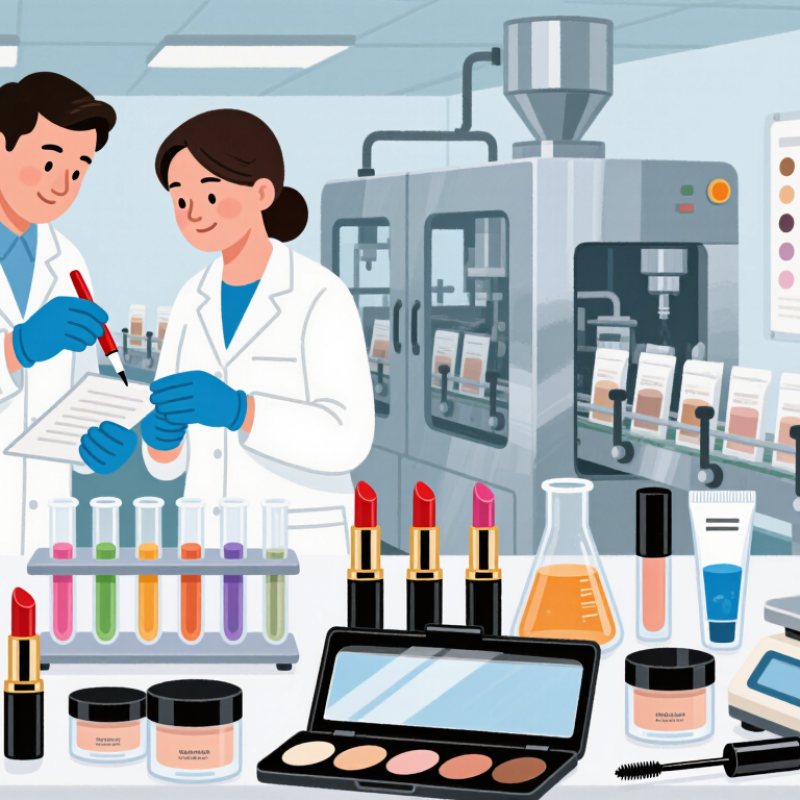
Who Are China's Top Private Label Makeup Manufacturers?

What Private Label Makeup Manufacturing Means in China

What Private Label Makeup Manufacturing Means in China

In China, private label makeup manufacturing is a service model: a factory produces cosmetics that another business sells under its own identity. The factory may offer OEM production using a buyer’s formula, or ODM support with product development, shade selection, and packaging. The boundary is not always neat. A buyer might provide a brief, then work through several rounds of formula and color adjustments. A lipstick can look different under daylight than under factory lighting. Small details matter.

China’s National Bureau of Statistics reported cosmetics retail sales of RMB 414.2 billion in 2023. That figure describes consumer spending, not factory output or private-label sales. McKinsey’s 2023 State of Beauty report estimated the global beauty market could reach about US$580 billion by 2027; it signals broad industry scale, not guaranteed demand for any single product. In practice, buyers should assess sample consistency, ingredient documentation, packaging compatibility, production lead times, and quality checks before placing larger orders. Ask for evidence. A polished sample alone is not enough. Manufacturing can reduce development work, but it cannot replace careful product decisions or clear communication.

What Private Label Makeup Manufacturing Means in China

This chart shows a typical workflow from product brief to production. The bars indicate step order only—not duration, market share, factory capacity, or a ranking of manufacturers. Exact processes vary by product and supplier.

How China’s Private Label Makeup Industry Is Organized

Who Are China's Top Private Label Makeup Manufacturers?

How China’s Private Label Makeup Industry Is Organized

China’s private label makeup industry is a network, not a single factory floor. Contract manufacturers may handle formulation, production, filling, and packaging. Some focus on color cosmetics, while others offer broader personal care capabilities. Ingredient suppliers, packaging makers, testing laboratories, and logistics providers support their work. Roles can overlap. The structure is not always tidy.

A product often moves through several teams before it reaches a buyer. A manufacturer may develop a shade, source pigments, fill tubes, and check batches for consistency. A separate packaging supplier might produce the compact or applicator. Buyers should ask who controls each step and how changes are approved. Request clear product specifications, sample records, and quality-check procedures. These details help reveal whether a supplier’s capabilities match the project. A polished sample is useful, but it cannot show every production risk.

Tips: Ask for a factory profile, production scope, and recent sample documentation. Confirm minimum order quantities, lead times, and who handles testing. Keep approvals in writing. Small details matter. A shade can shift between sample and bulk production, so confirm color standards before manufacturing.

Who Are China's Top Private Label Makeup Manufacturers? - How China’s Private Label Makeup Industry Is Organized
Industry participant Typical role Common deliverables Useful evaluation signals China-specific operating context
Integrated OEM/ODM makeup manufacturers Produce cosmetics to a buyer’s specification (OEM), or offer product development and manufacturing services (ODM). Formulation development or adaptation, raw-material procurement, bulk production, filling, packaging coordination, and batch records. Relevant product-line experience; documented quality controls; sample-to-production consistency; clear ownership of formulas, tooling, and specifications. The manufacturer’s permitted scope and facility capabilities should match the product and manufacturing activities being commissioned.
Color-cosmetics specialists Focus on makeup categories such as lip products, complexion products, powders, eye products, or pencils. Category-specific formulas, shade development, bulk manufacture, filling, and product stability or compatibility work as appropriate. Demonstrated process capability for the requested format; repeatable shade matching; suitable filling equipment; product-specific testing plans. Capabilities are not interchangeable: equipment and process controls suitable for one makeup format may not suit another.
Formulation and product-development teams Develop, adapt, or assess formulas and translate a product brief into a manufacturable specification. Lab samples, ingredient and formula documentation, shade or texture iterations, and support for scale-up and product testing. Transparent revision process; documented ingredient information; defined acceptance criteria; evidence that the formula can be scaled consistently. Formula development does not replace the applicable product safety, registration, filing, or manufacturing obligations.
Packaging and component suppliers Supply components used to contain, dispense, protect, and present makeup products. Components such as containers, closures, applicators, and decoration; samples and component specifications. Dimensional and material specifications; component availability; compatibility checks; quality inspection and change-control processes. Packaging is often coordinated with the manufacturer, but component sourcing and responsibility should be stated clearly in the contract.
Testing and quality-service providers Provide testing or technical services that support product assessment and quality assurance. Testing reports or other agreed technical records, depending on the product, test method, and service scope. Relevant test scope and methods; suitable laboratory competence; clear sample handling and reporting; documented corrective-action process. Testing requirements depend on the product and applicable rules; a service provider’s report does not itself guarantee regulatory compliance.
Regulatory and compliance support Help organize product information and coordinate regulatory work for the intended market. Document coordination, labeling review, ingredient information, and support with applicable filing or registration tasks. Defined responsibilities; current knowledge of relevant rules; traceable documents; clarity about which party is accountable for each submission. In China, ordinary cosmetics generally follow a filing route and special cosmetics require registration; the appropriate route depends on product classification and applicable rules.

Note: This table maps common industry roles, not a company ranking. China’s cosmetics regulations require domestic cosmetics manufacturing to take place at facilities holding the applicable cosmetics production license. Confirm current requirements, product classification, facility scope, and contractual responsibilities for each project.

How to Identify Leading Chinese Makeup Manufacturers

How to Identify Leading Chinese Makeup Manufacturers

McKinsey’s 2023 beauty market report projected that global beauty sales could reach $580 billion by 2027. Growth alone does not identify a capable supplier. Buyers should check whether a manufacturer actually produces makeup in-house, and whether its equipment suits the requested formats. Ask to see production areas, batch records, and quality-control procedures. A polished showroom proves little. Look for documented controls, such as procedures aligned with ISO 22716 cosmetics good manufacturing practices.

Assess technical fit through a detailed product brief and sample review. Check pigment dispersion, texture, packaging compatibility, and batch-to-batch consistency. Ask how the factory handles raw-material traceability, stability testing, and corrective actions when results fall outside specifications. Confirm the sample and production versions use the same approved formula and process. No audit is perfect; records still need careful review.

Tips: Request a recent independent audit, relevant quality certificates, and a written test plan. Verify certificate scope and expiry dates with the issuing body. Compare sample quality, minimum order quantities, lead times, and communication clarity. Keep an evaluation record. A low quote may hide added costs or unclear responsibilities, so ask for a complete quotation and written production specifications before making a decision.

Key Manufacturers and Their Product Specialties

China’s private-label makeup manufacturers differ more by process than by catalog size. Many Guangdong-based OEM and ODM factories focus on color cosmetics, including pressed powders, lip products, liquid foundations, and eye makeup. Their strengths may include shade matching, formula adjustment, and packaging coordination. Capabilities vary, though. A broad product list does not prove equal expertise across every formula.

The National Bureau of Statistics reported cosmetics retail sales of RMB 435.2 billion in China in 2024, up 2.8% year over year. This measures the whole cosmetics market, not private-label sales. McKinsey’s 2023 beauty-market analysis projected global beauty sales could reach about $580 billion by 2027, underscoring continued product-development activity. For buyers, the useful question is whether a supplier can reproduce a sample consistently. Ask for batch records, stability-test results, and shade tolerances. Check how the factory handles a formula change after approval. Not every supplier does everything well. One limitation: public data rarely separates makeup factories by specialty, so factory audits and product-specific testing remain essential.

How to Compare Suppliers by Quality, Compliance, and Capacity

Choosing a private label makeup manufacturer takes more than comparing quoted prices. Ask how each supplier controls formula changes, incoming ingredients, and finished-product batches. Request recent quality records, not just a polished presentation. A stable shade should look consistent across several production samples, not only one lab swatch. Small details matter.

Review compliance processes against the markets where the products will be sold. Check that ingredient documents, product specifications, safety assessments, and label reviews are available and kept current. Ask how complaints and batch recalls are documented. Clear answers build confidence. Vague assurances do not. Requirements can vary by product and market, so confirm details with qualified regulatory professionals rather than relying on a supplier’s general promise.

Capacity needs evidence, too. Compare stated monthly output with equipment, staffing, lead times, and current production commitments. Ask whether pilot batches use the same process and controls as larger runs. A factory may have impressive machinery but limited room in its schedule. I would still treat forecasts cautiously: samples cannot reveal every production problem, and supplier questionnaires rarely tell the whole story. A thoughtful site review or independent quality audit can fill some gaps.

Article Source:

ACCESS ABILITY Home Medical Store has a Beautiful showroom in Cudahy To Serve You!

Corporate Office And Store
Cudahy, Wisconsin

1995 E Norse Ave
Cudahy, WI 53110
Phone: 414-486-6249
Fax: 414-486-5728