
How to Choose the Best Multipurpose Electric Kettle in 2026?

A Multipurpose Electric Kettle can boil water, brew tea, and sometimes prepare soups or other simple foods. But extra functions are useful only when they suit your daily routine. A crowded control panel cannot compensate for a poor pour or hard-to-clean interior.

Grand View Research estimated the global electric kettle market at approximately US$1.51 billion in 2023. Its report projected a 5.2% compound annual growth rate from 2024 through 2030. These figures describe the broader kettle market, not multipurpose models alone. That distinction matters. Market growth signals consumer interest, but it does not prove that a particular kettle is dependable or good value.

Choosing well means checking the details you will notice at home. Consider capacity, heating speed, temperature settings, keep-warm performance, and whether the inner surface is easy to clean. Look closely at handle comfort, lid opening, spout control, and the clarity of the water-level marks. Small details matter. A kettle that splashes onto the counter or traps residue can become irritating fast.

This guide compares practical features and explains which claims deserve closer scrutiny. It also considers safety protections, warranty terms, and the space available on your countertop. Manufacturer specifications can help, but they are not independent test results. That limitation is easy to miss. Use them alongside credible product testing and your own needs before deciding which model belongs in your kitchen.
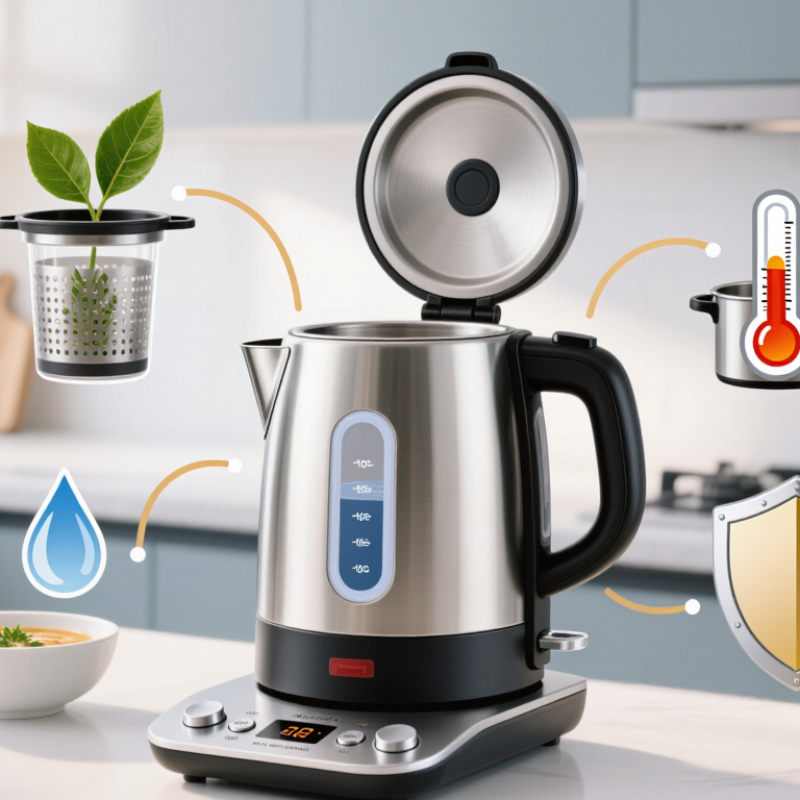
How to Choose the Best Multipurpose Electric Kettle in 2026?

Identify Your Main Uses Against SCA’s 90–96°C Coffee-Brewing Range

Start with the drinks you make most often, not the longest feature list. For pour-over coffee, the Specialty Coffee Association’s commonly cited brewing range is 90–96°C. It offers a useful target, not a guarantee of a good cup. Grind size, contact time, and water quality still matter. Small differences can show up in a thin, sour mug.

If coffee is your main use, choose a kettle with adjustable temperature across that range. Check whether it can hold heat and whether its display reflects the water temperature. A gooseneck spout can help you pour slowly over a paper filter; it matters less for a French press. You can compare the kettle’s reading with a reliable thermometer. Readings may drift.

For green tea, delicate leaves may call for cooler water, while instant meals often need hotter water. If you also use the kettle for oatmeal or soup preparation, consider its capacity, minimum fill, and ease of cleaning. Not glamorous. But practical. I would not chase a perfect number: kitchen conditions and pouring speed can change the water temperature before it reaches the coffee grounds.

Match Capacity and Wattage to Household Needs and Local Power Limits

Choose capacity around the amount you actually boil. A one- or two-person home may manage well with a 0.8–1.2 litre kettle, while families often benefit from 1.5–1.7 litres. Measure a usual serving in your mug; kettle markings can be surprisingly generous. Two cups, not a full pot. Boiling only the water you need can save time and energy. A larger model is handy for cooking, but it takes more counter space and may tempt you to heat excess water. That trade-off is easy to miss.

Wattage affects heating speed and the electrical load. A higher-wattage kettle can boil water faster, but it may not suit every home’s power supply or shared circuit. Check the appliance’s voltage and wattage against your local supply and the outlet’s circuit rating. In some places, household limits are lower than shoppers expect. If a kitchen circuit also runs a toaster or microwave, avoid assuming both can operate at full power together. Check the manuals, and ask a qualified electrician if the circuit rating is unclear. It is a small step, but worth taking. Don’t rely on a plug adapter to solve a voltage mismatch; verify the kettle is designed for your region.

Compare Temperature Presets, Keep-Warm Functions, and Control Accuracy

How to Choose the Best Multipurpose Electric Kettle in 2026?

A multipurpose electric kettle is most useful when its temperature settings suit what you actually brew. Green tea often benefits from cooler water, while black tea and coffee usually need hotter water. Exact preferences vary, so treat preset temperatures as a helpful starting point, not a rule. Check whether the controls offer several useful steps or only a few broad options. Control accuracy matters, too: a kettle may display a target temperature without holding it precisely. Sensor placement, water volume, and starting temperature can all affect the result. A small cup can reveal inconsistencies quickly.

Tips: Test a setting with the amount of water you normally use. If results seem off, compare the display with a separate kitchen thermometer. Allow for a little variation.

A keep-warm function helps when you refill a cup slowly or prepare more than one drink. Check how long it holds the water and whether you can choose the temperature. Longer holding times are convenient, but they may use more energy. Look for clear controls, a readable display, and an audible signal you can hear from nearby. I’ve found that extra presets can look impressive, yet become clutter if they do not match your routine. Think about cleaning, too: a wide opening makes it easier to reach the interior and notice mineral buildup.

Check Food-Contact Materials and IEC 60335-2-15 Safety Compliance

When choosing a multipurpose electric kettle in 2026, look closely at every surface that touches water or food. Stainless steel, glass, and food-grade silicone are common choices, but the material name alone proves little. Check the product manual or supplier documentation for clear food-contact information, including details about coatings, seals, and removable parts. Small details matter. A smooth interior can still have a coated lid or silicone gasket that deserves a closer look.

IEC 60335-2-15 addresses safety requirements for household appliances that heat liquids. Ask for documentation tied to the exact model, such as a test report or conformity statement, and confirm which standard edition was used. Do not treat an IEC reference as proof that every food-contact material has been assessed; these are separate checks. It is easy to miss that distinction. Also inspect practical safeguards: a stable base, secure lid, automatic shutoff, and protection against boiling dry. These features should be described in the instructions, not just shown in product photos. If paperwork is vague, pause and ask for clarification. A kettle may look reassuring on a counter, but reliable evidence is more useful than polished claims.

How to Choose the Best Multipurpose Electric Kettle in 2026? — Check Food-Contact Materials and IEC 60335-2-15 Safety Compliance

Use this comparison checklist to assess materials, everyday functions and safety documentation. Food-contact compliance and electrical safety are separate checks; one does not prove the other.

Buying dimension What to check Practical guidance Evidence to look for
Food-contact surfaces Identify every surface that may touch water, steam condensate or ingredients, including the inner vessel, lid underside, spout filter and seals. Prefer clearly identified food-contact materials and a design that makes these surfaces easy to inspect and clean. Do not assume that a “stainless steel” label describes every internal part. Product documentation naming the materials and stating compliance with food-contact requirements applicable in the market where the kettle is sold.
Stainless-steel interior Check whether the water-contact interior is stainless steel and whether the material specification is provided. Stainless steel is a common kettle-vessel material. It can still develop deposits or corrosion under unsuitable water and care conditions, so follow the cleaning instructions. Material description, care instructions and any applicable food-contact declaration or test documentation.
Glass interior Check which parts are glass and which remain plastic or metal, particularly around the lid, rim, filter and seals. Glass lets users see the water and limescale. Inspect the kettle for accessible joints and follow instructions to avoid thermal shock or impact damage. Materials list and cleaning or handling instructions; confirm that all water-contact components are covered.
Plastic components Check whether plastic contacts water or steam, and whether the supplier specifies the intended food-contact use and temperature conditions. Plastic is not automatically unsuitable, but its compliance depends on the material, conditions of use and applicable rules. Avoid relying on “BPA-free” alone as proof of overall food-contact compliance. Food-contact declaration or supporting documentation for the relevant jurisdiction and intended conditions of use.
Food-contact rules Check the requirements for the sales market. For example, the EU framework includes Regulation (EC) No 1935/2004; plastic food-contact materials are also covered by Regulation (EU) No 10/2011. Rules vary by jurisdiction and material. In the United States, food-contact substances are subject to applicable FDA requirements. Verify the specific product and intended use rather than relying on a generic claim. Market-specific declarations, applicable test reports or other supporting records. These are distinct from IEC electrical-safety documents.
IEC electrical safety Look for safety evaluation to IEC 60335-2-15, the particular requirements for appliances for heating liquids, used together with IEC 60335-1. Confirm the documentation applies to the model and configuration being purchased. The applicable edition or national adoption may differ by market and date. Test report or certification documentation identifying the product model and the applicable IEC or national standard. A logo alone may not show the scope of evaluation.
Overheating and dry-boil protection Check the instructions and product specifications for automatic shut-off and protection against operation with insufficient water. These protections can reduce risks during ordinary use, but they do not replace supervision, correct filling or following the manufacturer’s instructions. Operating instructions and safety documentation for the exact model.
Temperature control Check whether the kettle offers selectable temperatures, a keep-warm function or only a boil setting. Variable settings can be useful for different drinks and recipes. Check the stated temperature range and whether the control is easy to use; do not assume the displayed temperature is laboratory-accurate. Instruction manual specifying settings, keep-warm duration and any stated temperature tolerance.
Capacity and minimum fill Compare the maximum and minimum fill markings with the amount of water normally needed. A suitable capacity helps avoid repeated boiling; observing the minimum and maximum lines supports safe operation and helps prevent overflow or dry boiling. Visible water-level markings and capacity information in the manual.
Cleaning and limescale care Check whether the lid opens widely, the filter can be removed and the instructions explain descaling. Regular descaling can help maintain heating performance, especially in hard-water areas. Use only cleaning methods permitted by the instructions. Cleaning and descaling guidance, including care instructions for the filter and seals.
Power, plug and local use Check the rated voltage, frequency, power and plug type against the electrical supply where the kettle will be used. Choose a model intended for the local market. Do not use a plug adapter to make an incompatible voltage or frequency rating suitable. Rating plate and manual showing electrical ratings and relevant local-market information.
Final selection Compare material transparency, documented food-contact compliance, model-specific electrical-safety evidence, capacity and cleaning requirements. A well-matched kettle is one whose materials and operating features suit your use and whose documentation is clear for your market—not simply the one with the most functions. Keep the manual and purchase records, and check that product identifiers match the documentation.

Note: This table is a general buying guide, not a substitute for checking the applicable laws, product documentation or safety instructions in your region.

Assess Cleaning Ease, Warranty Coverage, and Long-Term Value

A multipurpose kettle earns its counter space only when cleaning remains manageable. Open the lid fully and check whether your hand or a soft brush can reach the bottom. Tea residue and mineral scale collect around the spout, filter, and lid hinge. Check the hinge. A removable filter helps, but tiny clips can be awkward to rinse. Avoid assuming that every part is dishwasher-safe; confirm this in the care instructions.

Warranty coverage deserves more than a quick glance at the number of years. Check what it excludes, how repairs are requested, and whether shipping costs fall to you. Some warranties cover electrical faults but not wear on seals or accessories. Keep the receipt and the care guide together. Read the fine print. A clear service process can be more useful than a long warranty with narrow conditions.

For long-term value, compare likely upkeep with how often you will use the kettle’s extra functions. A low price may look appealing, yet replacement filters or hard-to-find lids can add friction later. Look for available spare parts and simple controls that are easy to wipe clean. A polished interior looks reassuring, but it does not prove lasting quality. That is easy to miss when shopping. If you rarely use the warming feature, its added cost may not be worthwhile.

ACCESS ABILITY Home Medical Store has a Beautiful showroom in Cudahy To Serve You!

Corporate Office And Store
Cudahy, Wisconsin

1995 E Norse Ave
Cudahy, WI 53110
Phone: 414-486-6249
Fax: 414-486-5728