
What Is the Difference Between Power Chairs and Scooters?
Choosing between power chairs and scooters is not simply a matter of comfort or price. Each device supports different mobility needs, body positions, and daily routines. A power chair usually offers more seating adjustments and precise indoor control. A scooter often provides a familiar tiller, easier transfers, and useful outdoor range.
The difference becomes clearer in real settings. Picture a narrow kitchen, a steep curb, or a crowded clinic hallway. A power chair may turn more smoothly and support posture during long use. A scooter may feel simpler for shopping trips, especially with a front basket and removable seat. However, neither option suits everyone. Small details matter.
A careful decision should consider balance, hand strength, vision, endurance, transfer ability, and home access. A licensed occupational therapist or mobility specialist can assess these factors and recommend suitable features. Users should also test the device on ramps, doorways, uneven pavement, and public transport when possible. Brochures rarely show the frustrating parts. A model may look ideal online but feel awkward after twenty minutes.
This guide compares power chairs and scooters through practical features, including maneuverability, seating, portability, battery use, maintenance, and typical environments. It also recognizes an uncomfortable truth: the “best” choice may change as health or living arrangements change. Some people need more support than expected. Others purchase advanced equipment they rarely use. Honest testing, professional advice, and realistic daily goals usually lead to a safer, more satisfying decision.
Definitions and Scope: Power Chairs Versus Mobility Scooters
What Is the Difference Between Power Chairs and Scooters?
Definitions and Scope: Power Chairs Versus Mobility Scooters
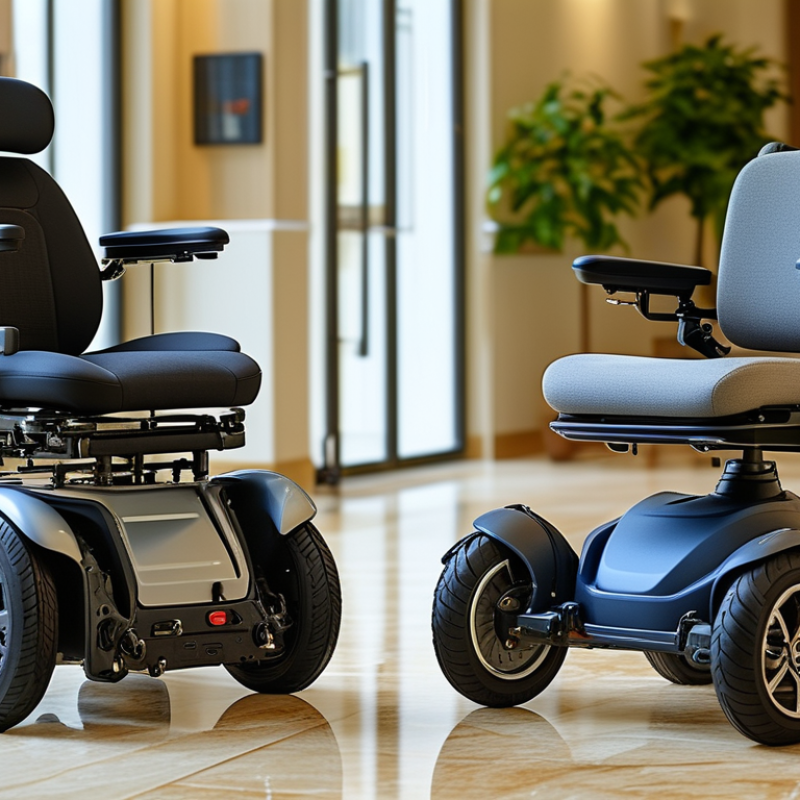
A power chair is a powered wheelchair designed for people needing substantial seating and mobility support. It usually uses a joystick and offers precise indoor control. Many models support posture, pressure management, and limited body movement. A mobility scooter typically has a tiller, a separate seat, and three or four wheels. It suits users who can sit steadily, steer with their hands, and transfer safely. These definitions are useful, but not absolute. Some products blur the boundary.
The scope also changes across clinical, insurance, and regulatory settings. A power chair is often assessed as complex assistive technology. A scooter may be treated as a less supportive mobility option. The correct choice depends on endurance, balance, home layout, transport needs, and daily terrain. The WHO and UNICEF Global Report on Assistive Technology estimates that more than 2.5 billion people need assistive products worldwide. Nearly 1 billion people lack access. That gap shows why simple labels can mislead. A quick showroom test cannot replace professional assessment.
Tips: Sit in both devices for several minutes. Test tight turns near a table. Check whether the tiller or joystick causes wrist strain. Measure doorways and vehicle storage space. Ask an occupational therapist to review posture and transfer safety. I would also recheck the decision after real-world use; comfort can change after one week.
| Comparison Dimension | Power Chair | Mobility Scooter |
|---|---|---|
| Basic Definition | A battery-powered wheelchair designed primarily for people who have significant difficulty walking or who need a wheelchair-style seating system. | A battery-powered mobility device with a separate seat, handlebars or a tiller, and a steering column, generally intended for people who can sit upright and transfer on and off the seat. |
| Primary Steering Method | Usually controlled with a joystick or another electronic control device mounted near the user’s hand. Alternative controls may be available for users with limited hand movement. | Usually steered with handlebars or a tiller that controls the front wheel or front steering assembly. |
| Seating and Positioning | Typically offers a wheelchair-style seat with more options for postural support, including adjustable armrests, foot supports, headrests, and specialized cushions. | Typically has a padded seat, backrest, armrests, and a swiveling seat. Positioning options are generally more limited than those available on complex power chairs. |
| Best Suited User Profile | Often better suited to users who require substantial mobility assistance, continuous seating support, powered repositioning, or customized driving controls. | Often better suited to users who can maintain sitting balance, operate a tiller safely, and make independent transfers or use assistance for transfers. |
| Indoor Maneuverability | Many models are designed for indoor use and can provide precise joystick control. Compact configurations may have a relatively small turning radius. | Can work well in open indoor areas, but the steering column and longer front section may make tight turns and narrow spaces more difficult. |
| Outdoor Capability | Performance varies by configuration. Models with larger drive wheels, suspension, and higher ground clearance are generally better suited to uneven outdoor surfaces. | Outdoor capability varies widely. Larger models may handle longer trips and moderate uneven surfaces, while compact models are generally intended for smoother, shorter routes. |
| Driving Control | Joystick control allows speed and direction to be adjusted with small hand movements and can support more precise maneuvering. | Tiller control requires the user to steer with both hands or one hand, depending on the design, and may require greater upper-limb control. |
| Turning Radius | Often designed for a comparatively tight turning radius, although the exact measurement depends on the drive-wheel configuration and chair size. | Usually requires more turning space because of the steering column and front-wheel arrangement, particularly in longer or larger models. |
| Portability | Standard and complex power chairs are usually heavy and may require a vehicle lift, ramp, or accessible transportation. Some compact models can be disassembled or folded. | Travel-oriented models may be disassembled into several sections or folded, while larger models can be heavy and require a ramp, lift, or adapted vehicle. |
| Adjustability | Generally provides more options for seat height, tilt, recline, leg support, control placement, and other seating or driving requirements. | Usually provides basic seat, armrest, tiller, and sometimes seat-height adjustments, with fewer advanced positioning functions. |
| Transfer Requirements | May be suitable for users who remain seated for long periods or who need specialized seating support. Transfer needs depend on the individual’s abilities and the chair configuration. | Normally requires the user to transfer onto a relatively high seat, although a swiveling seat can make transfers easier for some people. |
| Battery and Charging | Uses rechargeable batteries; battery capacity and travel range depend on the battery type, user weight, terrain, speed, temperature, and accessories. | Uses rechargeable batteries under the same general conditions. Larger batteries may provide greater range but can increase overall weight. |
| Typical Speed Range | Many consumer models have maximum speeds in the approximate range of 4 to 8 km/h, although legal limits and product specifications vary. | Many consumer models have maximum speeds in the approximate range of 6 to 15 km/h, depending on their intended use and local regulations. |
| Transport and Storage | Often needs dedicated storage space and transportation equipment, especially when the chair includes powered seating functions or heavy-duty components. | Compact units may fit in some vehicle storage areas after disassembly, while full-size units may require a vehicle lift or ramp. |
| Customization Potential | Usually offers greater potential for clinical customization, including alternative drive controls, seating systems, pressure management, and postural support. | Usually offers more standardized configurations, with customization focused mainly on comfort, steering position, seat adjustment, and accessories. |
| Main Advantages | Precise control, stronger seating and positioning support, better adaptability for complex mobility needs, and good maneuverability in suitable configurations. | Simple operation for appropriate users, comfortable upright seating, easy boarding on many models, and a broad range of compact and outdoor-oriented designs. |
| Main Limitations | Can be expensive, heavy, less convenient to transport, and more dependent on professional assessment and configuration. | May provide less postural support, require stronger arm and hand control, need more turning space, and be less suitable for users with complex seating needs. |
| Professional Assessment | A seating and mobility assessment by an appropriate healthcare or rehabilitation professional is especially important when the user has complex postural, neurological, or pressure-management needs. | Assessment is still important to confirm safe steering, braking, transfers, seating posture, visibility, and the user’s ability to manage the intended environment. |
| Overall Scope | Primarily a wheelchair replacement or long-term mobility solution for users who need powered mobility and more comprehensive seating support. | Primarily a walking-support and community-mobility solution for users who retain enough strength, balance, and coordination to operate a tiller and transfer safely. |
Related Posts
-

How to Choose the Right Wheel Chair for Your Needs?
-

Why Should You Consider Using a Wheel Chair for Enhanced Mobility?
-

Top 10 Mobility Products for Enhanced Independence and Comfort?
-
Top 10 Mobility Aids for Global Buyers in 2026?
-
Top 5 Mobility Scooters You Should Consider Buying Now?
-

Top Home Hospital Equipment to Consider for Global Buyers?