
CALL TODAY for FREE In home consultation
SEND EMAIL
1995 East Norse Avenue
Cudahy, Wisconsin 53110
414-727-2524
4445 W Forest Home Avenue
Milwaukee, Wisconsin 53219
414-727-2525
2140 American Drive
Neenah, Wisconsin 54956
920-257-6060
65 Copeland Avenue
La Crosse, Wisconsin 54603
608-784-9980
Choosing a Surface Mounted Light can solve practical problems without turning a ceiling into a construction project. It sits directly against the ceiling or wall, making it useful where recessed fittings are difficult to install. Think of a low hallway, a concrete ceiling, or a room with limited ceiling depth. The fixture remains visible, so its shape and finish become part of the room’s design.
Lighting designer Richard Kelly is often credited with the observation, “Light is the magical ingredient that makes or breaks a space.” That idea applies here: a fitting is not just a bright spot overhead. Its beam spread, color temperature, and position affect how a kitchen counter, entryway, or reading corner feels. A broad diffuser can soften shadows, while a directional model can highlight a specific surface. Check the manufacturer’s specifications, and match the output to the room’s actual tasks.
There are trade-offs. A surface-mounted fixture may look bulky on a low ceiling, and one central light can leave corners dim. Not every room needs the same solution. This guide explores fixture types, placement, brightness, design, and installation considerations, so readers can compare options with clearer expectations. A small detail matters: even a well-chosen light can feel harsh when aimed poorly. That deserves a second look.
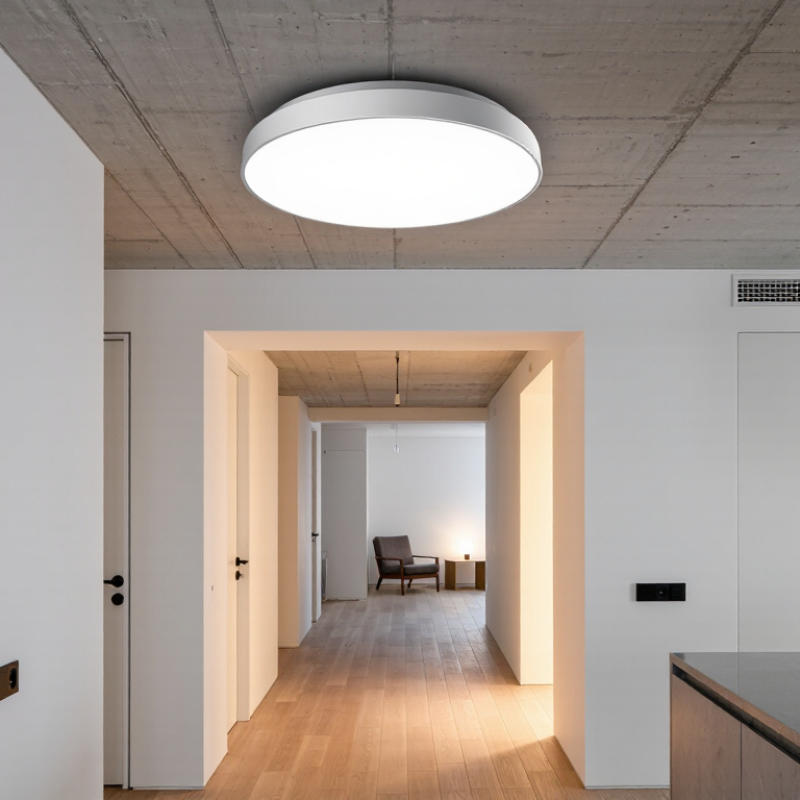
A surface-mounted light is a fixture attached directly to a ceiling or wall, rather than recessed into a cavity. Its base, mounting plate, and shade remain visible. In many installations, the plate covers a ceiling junction box, while the lamp sits below the surface. This makes the fitting useful where there is little space above the ceiling, such as beneath a concrete slab or in a shallow renovation. No ceiling cavity is needed. The profile can vary: a slim disk sits close to the ceiling, while a deeper shade hangs lower and distributes light differently.
Installation still deserves care. The fixture must suit the junction box, wiring, room conditions, and the lamp’s heat requirements. A qualified electrician can check those details, especially when replacing an old fitting or encountering unfamiliar wiring. For everyday use, view the light from the doorway and seating area, not only from directly beneath it. A broad diffuser may soften shadows over a kitchen counter; a narrow shade can leave corners dim. Surface-mounted lights are not automatically the neatest choice. Their visible bases can feel prominent in a small room, so consider the proportions before choosing one.
A surface-mounted light attaches directly to the ceiling, making it a practical option when a recessed ceiling cavity is unavailable or unsuitable.
How to read this chart: 1 means the feature typically applies; 0 means it typically does not. Surface-mounted fixtures sit below the ceiling surface, while recessed fixtures are installed into a ceiling cavity. Specific designs and ceiling conditions vary.
Surface-mounted lights attach directly to the ceiling, making them useful where recessed fittings are impractical. Installation begins with checking the ceiling material, fixture weight, and available wiring. Turn off the circuit at the breaker, then confirm the wires are not live with a suitable tester. Never rely on the wall switch alone. Secure the mounting bracket to a joist or an appropriate ceiling anchor. The fixture must sit firmly, without rocking.
Tips: Keep it level. Check the fixture instructions before connecting wires; wire colors can vary by location and installation. If the wiring is damaged, unfamiliar, or difficult to identify, stop and contact a qualified electrician.
Connect the wires according to the fixture diagram, including the earth connection where required, and keep all connections inside the covered electrical box. Fit the light to its bracket, then restore power and test it. A slight gap or crooked edge can be easy to miss from a ladder, so step back and inspect the fit before finishing. If the ceiling flexes or the light feels loose, do not treat that as a minor cosmetic issue; reassess the support.
Surface-mounted fixtures attach directly to the ceiling, so they do not need a recessed cavity. That makes them practical for concrete ceilings, narrow hallways, and renovations where cutting into the ceiling is difficult. A compact fixture can sit above a kitchen counter or stair landing, putting light where daily tasks happen. One drawback: the fixture stays visible, so its depth and position matter in a low room.
Energy savings depend on the light source, not just the mounting style. The U.S. Department of Energy reports that LED lighting uses at least 75% less energy and can last up to 25 times longer than incandescent lighting. These figures are comparisons with incandescent lamps; actual savings vary with use and fixture design. A well-matched LED surface light can reduce replacement work, too.
The International Energy Agency estimates that lighting accounts for about 15% of global electricity consumption, making efficient choices worthwhile at scale. Surface-mounted fixtures are also accessible for cleaning and maintenance, especially on high-use ceilings. Still, easy installation does not guarantee good light. Check the beam spread and glare before choosing; a bright spot over a dining table can feel harsher than expected.
Surface-mounted lights work especially well where the ceiling is solid, shallow, or difficult to open. Think exposed concrete in a basement, a narrow apartment corridor, or a stairwell with limited ceiling space. The fixture sits below the surface, so installation usually avoids cutting a large recess into the ceiling. That can make it a practical option for renovations and utility rooms. A practical fit.
They can also serve garages, workshops, and kitchens, where direct, usable light matters. Match the fixture’s distribution to the task: a broad beam can reduce dark patches in a hallway, while focused light may suit a workbench. Check ceiling height and glare, too. A bright fitting mounted close to eye level can feel harsh, even when the room’s overall light level seems adequate. Not everywhere.
The U.S. Energy Information Administration’s 2018 Commercial Buildings Energy Consumption Survey reports that lighting accounts for about 17% of commercial-building electricity use. That figure does not mean surface-mounted fixtures automatically save energy; lamp efficiency, controls, and operating hours matter. Still, accessible fixtures can make maintenance simpler, especially where recessed housings are impractical. One detail is easy to miss: surface mounting can make a low ceiling feel lower. Review the room layout and lighting plan before choosing.
Why Choose a Surface Mounted Light?
How to Choose the Right Surface-Mounted Light
Start with the room and ceiling. A surface-mounted fixture works well when a recessed housing cannot fit, but its depth still matters. Measure from the ceiling to doors, cabinets, and tall furniture. In a low hallway, a slim profile reduces bumps and visual clutter. Check the dimensions.
Choose brightness by lumens, not wattage alone. The U.S. Department of Energy reports that LED lighting uses at least 75% less energy and lasts up to 25 times longer than incandescent lighting (DOE, “LED Lighting”). That makes LED efficiency worth checking, but it does not guarantee comfortable light. Compare lumen output and look for a diffuser that softens bright points. Photos can mislead. The International Energy Agency estimates that lighting accounts for around 15% of global electricity consumption (IEA, “Lighting”). Efficient lamps can help, though the right output depends on the room’s size and task.
For kitchens and work areas, check color rendering and color temperature before buying. A high color-rendering index can make food and finishes appear more natural; warmer light often feels calmer in bedrooms. Verify that the fixture suits damp locations before using it in a bathroom. Also confirm dimmer compatibility, driver access, and the electrical box’s support for the fixture’s weight. I would not judge color from a screen alone. A sample viewed at home can reveal an unexpected blue or yellow cast.
Surface-mounted lights attach to the ceiling or wall without requiring a recessed cavity. Use this guide to compare common fixture types and match a light to the room, mounting surface, and lighting needs.
| Fixture Type | Typical Light Distribution | Common Applications | Key Selection Considerations | When It Is a Practical Choice |
|---|---|---|---|---|
| Flush-mount ceiling light | Broad, general illumination from a fixture close to the ceiling. | Bedrooms, hallways, closets, and rooms with lower ceilings. | Check fixture diameter, light output, glare control, and whether the diffuser can be cleaned or replaced. | Choose it when a compact profile and even ambient light are priorities. |
| Semi-flush ceiling light | General light directed outward and downward, often with some light reaching the ceiling. | Living areas, dining spaces, and bedrooms with enough ceiling clearance. | Confirm the fixture’s overall drop and ensure it will not obstruct movement or sightlines. | Choose it when you want a decorative fixture with more visual presence than a flush mount. |
| Surface-mounted linear light | Elongated light distribution along a counter, work area, corridor, or other linear space. | Kitchens, utility rooms, workshops, and offices. | Match the fixture length and light distribution to the task area; check whether the light source is integrated or replaceable. | Choose it when a longer, continuous area needs practical, general or task lighting. |
| Surface-mounted spotlight | Focused or directional light; some models allow the light head to be aimed. | Accent lighting, display areas, kitchens, and rooms needing directional illumination. | Check beam angle, aiming range, glare, and whether the beam can be positioned where needed. | Choose it when you need to highlight an object or direct light to a specific task area. |
| Surface-mounted wall light | Light may be directed upward, downward, or outward, depending on the design. | Bedrooms, hallways, living spaces, and covered exterior locations when the fixture is rated for them. | Consider mounting height, light direction, switch access, and the fixture’s suitability for damp or wet locations. | Choose it when wall-mounted ambient, accent, or bedside lighting is more suitable than a ceiling fixture. |
| What to Check | How to Choose |
|---|---|
| Room and task | Decide whether the light is for general illumination, focused work, or accent lighting. A room may need more than one lighting type. |
| Brightness | Compare light output in lumens rather than relying only on wattage. The appropriate output depends on room size, ceiling height, surface colors, and the task. |
| Color appearance | Check correlated color temperature (CCT), measured in kelvins. Lower values generally appear warmer; higher values generally appear cooler. |
| Dimming and controls | If dimming is required, confirm that both the fixture and the chosen control are compatible. Check product instructions for supported control types. |
| Ceiling or wall conditions | Verify mounting requirements, available electrical connections, fixture weight, and clearance. Use a suitable mounting box or support for the fixture and surface. |
| Moisture exposure | For bathrooms or outdoor areas, select a fixture with a location rating appropriate to the actual exposure and follow local electrical requirements. |
| Maintenance | Review how to clean the diffuser and whether the light source or driver is replaceable. Follow the manufacturer’s instructions for servicing. |
Always check the fixture’s installation instructions, electrical ratings, and local code requirements. Electrical work should be performed by a qualified person when required.
1995 E Norse Ave
Cudahy, WI 53110
Phone: 414-486-6249
Fax: 414-486-5728