
What Are the Best Lift Chairs in 2026?
Choosing among lift chairs in 2026 is not just a matter of comparing prices or counting features. The right chair should fit the person, the room, and the routines that happen every day. Think about standing from a low seat, reaching the controls, and finding a comfortable position for an afternoon rest. Small details matter.
A useful principle from rehabilitation engineer Dr. Rory Cooper’s assistive-technology work is to match equipment to a person’s real needs. In editorial paraphrase, not as a verbatim quotation: “Choose around the person’s daily life, not just the feature list.” That perspective helps frame this guide. It is not a substitute for an individual assessment, especially when balance, pain, or transfer needs are involved.
The sections ahead compare chair types, lift and recline functions, sizing, upholstery, controls, warranties, and practical safety considerations. We will also look at what product descriptions may leave unclear, such as seat depth, footrest support, and space needed behind the chair. A model can look ideal online and still feel awkward in a small living room. That happens.
Rather than naming a universal winner, this guide explains which features may suit different users and what to verify before buying. Check measurements against the intended user and room. Ask a clinician or qualified mobility professional when individual support needs are uncertain. The best choice is usually the one that works comfortably, consistently, and safely at home.
What Lift Chairs Are and How Their Lift Mechanisms Work
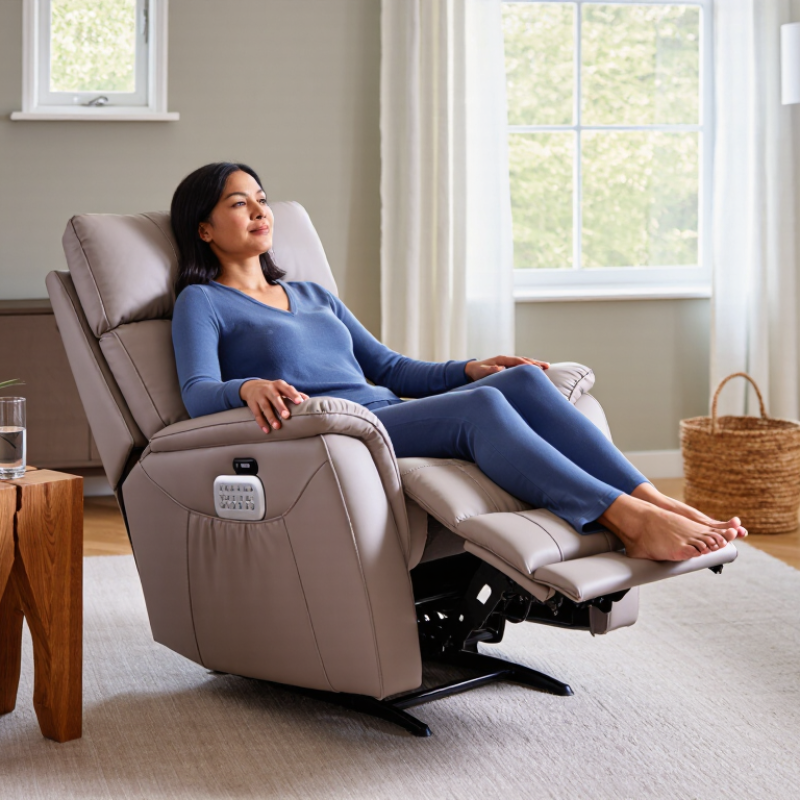
A lift chair is a recliner with a powered frame that helps move a seated person toward standing. It does not lift someone by the arms. Instead, a motor tilts the seat and backrest forward, raising the sitter gradually while their feet remain near the floor. The chair can also lower someone into a seated position with controlled movement.
The mechanism sits beneath the seat, usually in a steel frame. A hand control sends power to the motor, which extends or retracts an actuator. In a single-motor model, the backrest and footrest generally move together. With multiple motors, they can adjust more independently, allowing positions such as a raised footrest with a fairly upright back. More settings are useful, but they can also mean more controls to learn. That matters.
A clear floor area helps the chair move without striking a table or wall. Before choosing one, check the user’s height and weight against the chair’s specifications, and measure the space it needs when fully reclined. The lifting motion should feel steady, not startling. It may take practice. Keep hands away from moving joints, and use the chair on a level surface. Even a good mechanism cannot compensate for a poor fit; seat depth, arm height, and foot support all affect comfort and stability.
What Are the Best Lift Chairs in 2026? — What Lift Chairs Are and How Their Lift Mechanisms Work
| Chair type | How the lift mechanism works | Reclining function | May suit | What to check |
|---|---|---|---|---|
| Two-position lift chair | An electric actuator tilts the chair’s base and seat forward to help the user move between sitting and standing. The same powered system operates the reclining motion. | Typically offers an upright position and a limited recline, often with the footrest moving in coordination with the backrest. | People who mainly need help standing and want a straightforward sitting or light-reclining option. | Confirm the recline range and whether the chair can be placed at the required distance from a wall. |
| Three-position lift chair | A powered lift actuator raises and tilts the seat forward; the chair’s reclining system provides additional positions. | Usually provides upright sitting, a deeper recline, and a near-flat resting position. The exact range differs by model. | People who want assistance standing along with more than one resting position. | Check the fully reclined dimensions, leg support, and whether the chair needs clearance behind it. |
| Single-motor lift chair | One motor generally coordinates the backrest and footrest as the chair reclines. A lift function moves the seat assembly forward to assist standing. | The backrest and footrest commonly move together, so their positions cannot be adjusted independently. | People who prefer simple controls and do not need separate backrest and footrest adjustment. | Try the movement sequence if possible; confirm that the coordinated recline feels comfortable. |
| Dual-motor lift chair | Separate motors typically operate the backrest and footrest, while a powered lift mechanism assists the transition toward standing. | Allows more independent adjustment of the backrest and footrest than a typical single-motor design. | People who want finer control over their sitting and resting positions. | Check the handset layout, available positions, and whether independent adjustment is included in the specific model. |
| Infinite-position lift chair | Often uses independently controlled powered sections to adjust the backrest and footrest; a separate lift action tilts the seat forward. | Can offer a broad range of positions, sometimes including a near-flat configuration. “Infinite” describes adjustable positioning, not unlimited motion. | People who want flexible positioning for sitting and resting throughout the day. | Verify the actual movement range and whether the chair’s dimensions fit the room when fully reclined. |
| Zero-gravity-style lift chair | Uses a powered lift system like other lift chairs; the recline mechanism raises and positions the legs relative to the torso. | Designed to approximate a reclined posture with the legs elevated. “Zero gravity” is a positioning description, not a guarantee of a medical effect. | People who prefer elevated-leg positions and find the chair’s specific recline comfortable. | Test the posture and confirm that the seat, backrest, and leg support fit the user’s body. |
| Petite or compact lift chair | Uses the same general powered lifting principle, with the seat and frame sized for a smaller fit. | Position options depend on the motor and model; compact sizing alone does not indicate a particular recline range. | People who need a shorter seat depth or a more compact overall fit. | Check seat height, seat depth, and the user’s feet-to-floor contact while seated. |
| Wide-seat or high-capacity lift chair | A powered mechanism tilts the seat forward for standing assistance. The frame and specified capacity are designed for a wider fit or higher stated load. | Recline options vary; wider seating does not necessarily mean a greater recline range. | People who need more seat width or a model with a higher stated weight capacity. | Compare seat width and weight capacity with the user’s needs, and follow the manufacturer’s operating limits. |
| Buying consideration | Why it matters |
|---|---|
| Seat fit | Seat height and depth affect foot support and posture. When seated, the user should be able to sit back comfortably with feet supported. |
| Lift and recline controls | Lift chairs are powered furniture, not devices that physically lift a person under the arms. The user operates the chair’s actuator using its controls; assistance may still be needed depending on the person’s abilities. |
| Power-loss provisions | Some models accept a battery backup, but availability and operation differ. Check the manual to learn whether backup power is supported and which functions it can operate. |
| Room clearance | Reclined chairs may extend backward or forward. Check the model’s placement and clearance requirements before choosing a location. |
| Safe operation | Keep hands, feet, and other objects clear of moving sections. Follow the product instructions and consult a qualified health professional if transfer or mobility needs are uncertain. |
Related Posts
-
What are the Best Lift Chairs for Comfort and Mobility?
-
What Are the Top Types of Power Lift Chairs in 2026?
-
How to Choose Mobility Lift Chairs for Global Buyers?
-

Top 10 Wheelchair Vans for Enhanced Mobility and Comfort
-
China Best Mobility Products for Global Buyers in 2026?
-

Top Home Hospital Equipment to Consider for Global Buyers?