How to Choose the Best Lift Chairs in 2026?

Choosing the best lift chairs in 2026 requires more than comparing prices, colors, and online ratings. The World Health Organization’s World Report on Ageing and Health highlights the importance of supportive environments that preserve mobility and independence. The CDC also reports that more than one in four older adults falls each year. These findings make stability, controlled movement, and safe transfers practical priorities, not optional extras. A chair should help someone rise smoothly from a firm seat, while leaving enough room for both feet to contact the floor.

This guide examines lift chairs through real-world details and evidence-based buying criteria. We will compare motor performance, reclining positions, weight capacity, seat height, pressure distribution, upholstery, remote controls, and battery-backup options. Industry analysis from Grand View Research describes the powered recliner market as a growing category, but market growth alone does not prove product quality. A popular model may still have a narrow seat, a noisy motor, or confusing controls. That matters.

The best choice depends on the user’s height, strength, room layout, and daily routine. A tall person may need a deeper seat; someone with limited hand movement may need larger buttons. We will also consider manufacturer warranties, published safety testing, return policies, and replacement-part availability. These details often reveal reliability better than polished advertising. I may not treat every premium feature as necessary. Sometimes, a simpler lift chair is safer and easier to use. This 2026 guide aims to make that decision clearer, more practical, and less influenced by guesswork.
How to Choose the Best Lift Chairs in 2026?

Define User Needs: WHO Says 1 in 6 People Will Be 60+ by 2030

1 in 6 people worldwide will be aged 60 or older by 2030. The number of people aged 60 and above may reach 1.4 billion, according to its Ageing and Health data. This shift makes personal mobility needs more important when choosing a lift chair.

Start with the user, not the furniture. A shorter person may need a higher seat, while a taller user may need deeper leg support. Measure hip width, knee angle, and the distance from the chair to the wall. The feet should rest firmly on the floor. Small details matter.

The chair should support safe transfers, controlled reclining, and simple hand controls. A 2021 AARP survey found that 77% of adults aged 50 and above want to remain in their current home. That preference makes reliable daily equipment valuable.

Consider emergency battery operation, washable fabric, and a quiet motor. An occupational therapist can assess posture, strength, and fall risk before purchase.

A common mistake is choosing the largest chair. Bigger is not always safer. Some users may struggle to rise from a soft, oversized seat.

Needs change, too. Recheck comfort after several weeks.

Compare Chair Types: 2-, 3-, and Infinite-Position Mechanisms

How to Choose the Best Lift Chairs in 2026?

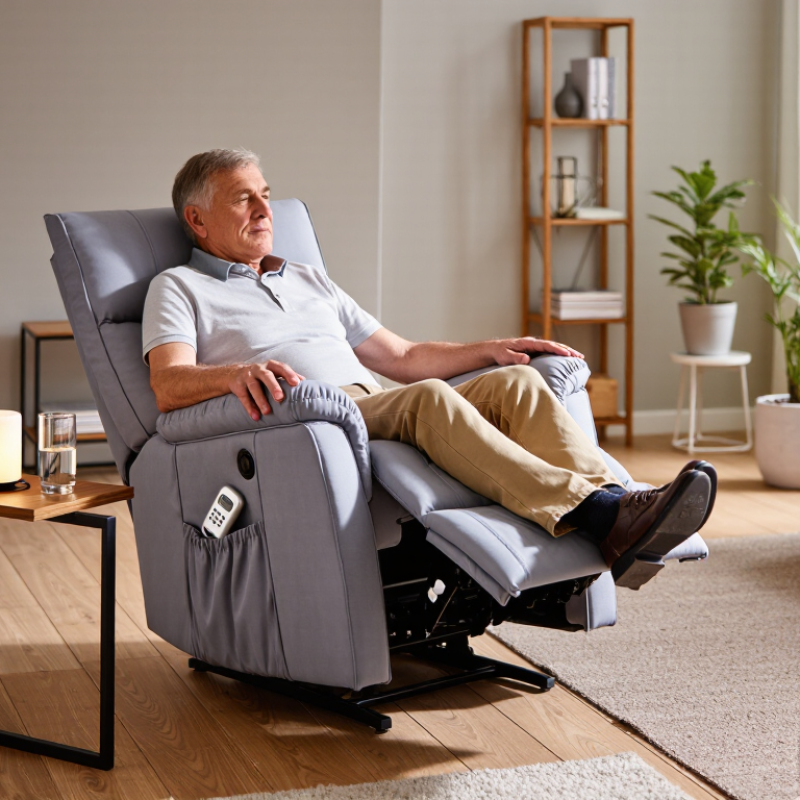
A lift chair should match your daily movements, not just your living room. A two-position chair usually supports sitting and a limited reading or resting angle. It suits users who need basic standing assistance and occasional reclining. The controls should feel clear, even with weak grip strength. Test the hand control before buying.

A three-position mechanism offers more flexibility. It commonly supports upright sitting, partial reclining, and deeper rest. This setup works well for reading, watching television, or taking an afternoon nap. Check whether your head and feet feel supported together. A chair can recline smoothly but still leave your knees poorly aligned. That detail is easy to miss.

An infinite-position chair adjusts the back and footrest separately. You can raise your feet while keeping your back mostly upright. You can also create a flatter position for longer rest. This design often helps users who change posture frequently, but it may require more precise control. More movement is not automatically better. Measure the chair, doorway, and available floor space carefully. Leave room for the footrest to extend. Real homes are rarely as spacious as showroom displays.

Seat width, cushion firmness, and lift speed deserve equal attention. Ask whether the chair moves quietly at night. Confirm its weight capacity and emergency power options from reliable product documentation. I once underestimated armrest height during a trial. That mistake made standing harder, despite the strong lifting mechanism. A short test can reveal a lot.

Measure Fit and Safety: CDC Finds 1 in 4 U.S. Adults Has a Disability

Choosing the best lift chair in 2026 begins with disability-aware measurement, not appearance. The CDC reports that about one in four U.S. adults has a disability, based on its Disability and Health Data System. That figure includes mobility, cognitive, hearing, vision, and self-care limitations. A chair must support the person’s actual movement pattern.

Measure hip width while seated, then add a few centimeters for winter clothing. Check seat depth from the back of the hips to the knees. Feet should rest flat when the chair is lowered. The footrest should not press behind the calves. I have found that a “comfortable” showroom chair can feel restrictive after twenty minutes. That mistake is easy to make.

Safety needs equal attention. The U.S. Consumer Product Safety Commission tracks thousands of furniture-related injuries each year, including falls involving recliners and chairs. Keep a clear path beside the chair, especially for walkers or caregivers. Confirm the lift cycle feels steady and stops without sudden movement. Review the manufacturer’s weight rating, emergency lowering procedure, and electrical safety instructions. The CDC’s 2022 Behavioral Risk Factor Surveillance System data also shows disability prevalence varies widely by age and state, so one standard fit cannot serve everyone. A tape measure helps, but a supervised trial is better. When possible, ask an occupational therapist to assess transfers, arm support, and pressure points. Small gaps remain in my own checklist: fatigue, swelling, and changing mobility can alter fit later.

How to Choose the Best Lift Chairs in 2026: Fit and Safety Context

CDC data show that about 1 in 4 U.S. adults reports a disability. Different disability types can affect chair fit, transfers, control access, and positioning needs.

Percentages represent U.S. adults reporting each disability type in the 2022 CDC Behavioral Risk Factor Surveillance System. Categories can overlap, so they should not be added together. When comparing lift chairs, check seat width and depth, arm support, footrest clearance, transfer height, and easy-to-reach controls.

Verify Standards: Check UL 962, Weight Rating, Clearance, and Controls

When choosing a lift chair in 2026, treat safety documents as seriously as comfort. Look for clear evidence of testing under UL 962, which covers household and commercial furnishing equipment. A reputable seller should provide certification details, not vague claims. Ask who performed the testing and whether the exact chair model was evaluated. Certification is not a substitute for careful installation. Read the fine print.

Check the weight rating against the user’s actual weight, clothing, and movement needs. A narrow safety margin may reduce stability and shorten the motor’s working life. Measure the room before ordering. The chair may need extra space behind it and in front of the footrest. Keep pathways clear near tables, walls, and electrical outlets. I once underestimated recline clearance by only a few inches. That mistake made the chair difficult to use.

Controls deserve hands-on testing. Buttons should have clear symbols, firm feedback, and enough spacing for limited hand strength. Try raising, reclining, and stopping the chair several times. Does the handset stay reachable from a seated position? A backlit control can help at night, though bright lights may disturb some sleepers. Check the power cord placement and confirm that emergency stopping instructions are easy to understand. A tidy showroom can hide awkward controls. Test them slowly, preferably while wearing normal clothing and shoes.

Compare Value: Warranty, Service Life, Features, and 2026 Total Cost

How to Choose the Best Lift Chairs in 2026?

A lift chair’s price is only the starting point. In 2026, compare warranty length, repair coverage, expected service life, and energy use. A $1,200 chair may cost more than a $900 model after battery replacement, delivery, and service visits. Check whether the warranty covers the motor, frame, remote, and upholstery separately. These parts often have different coverage periods.

Service life deserves careful attention. A strong frame and replaceable battery can support daily use for seven years or longer, but heavy use may shorten that estimate. Test the lifting motion in a showroom if possible. Listen for grinding sounds. Check whether the footrest closes evenly. Useful features include emergency battery backup, easy-clean fabric, adjustable head support, and a simple remote. More features are not always better.

Tips

Write down the five-year cost before buying. Add the chair price, delivery, repairs, batteries, and possible fabric replacement. Ask who performs local repairs and how long parts remain available. Read the warranty exclusions, especially for moisture, accidental damage, and normal wear. My estimates may be imperfect because usage differs widely. A lighter user may value quiet movement, while someone using the chair throughout the day may need stronger motor coverage. Leave room for that difference.

How to Choose the Best Lift Chairs in 2026? — Compare Value: Warranty, Service Life, Features, and 2026 Total Cost

Lift Chair Category Typical 2026 Purchase Price Recommended User Profile Core Features Typical Warranty Structure Expected Service Life Estimated 5-Year Maintenance Cost Estimated 2026 Total Cost of Ownership Value Rating
Single-Motor Basic Lift Recliner $450–$800 Occasional assistance with standing and sitting Two-position recline, powered lift function, hand control, removable back, standard foam cushioning Commonly 1 year for parts and labor; motor and frame coverage may differ Approximately 5–7 years with normal household use $100–$250 for handset, transformer, or minor mechanical repairs $550–$1,050 Good
Dual-Motor Independent Lift Recliner $750–$1,300 Users who need separate backrest and footrest positioning Independent back and footrest adjustment, lift assistance, improved positioning, stronger actuator system Commonly 1–2 years for parts; selected structural components may receive longer coverage Approximately 7–10 years with regular maintenance $150–$350 for controls, actuators, wiring, or power components $900–$1,650 Very Good
Heavy-Duty Lift Chair $1,000–$1,800 Larger users or households requiring higher weight capacity Reinforced frame, wider seat, higher-capacity motor, heavy-duty upholstery, enhanced stability Commonly 1–3 years for parts; frame coverage is often longer than electrical coverage Approximately 8–12 years when used within the rated capacity $180–$400 for electrical parts, upholstery wear, or mechanical service $1,180–$2,200 Very Good
Three-Position Lift Recliner $900–$1,600 Users who want upright, TV, and near-flat resting positions Extended recline, lift function, padded armrests, head and lumbar support, upgraded cushioning Commonly 1–2 years for parts and labor; coverage varies by motor and upholstery Approximately 7–10 years with moderate daily use $150–$350 for control systems, motor components, or cushion replacement $1,050–$1,950 Very Good
Zero-Gravity or Infinite-Position Lift Chair $1,300–$2,500 Frequent users needing precise pressure and leg elevation control Multiple positioning options, elevated leg support, zero-gravity positioning, enhanced head and lumbar support Commonly 1–3 years for electrical parts; frame coverage may be longer Approximately 8–12 years with careful daily use $200–$500 for actuators, control units, wiring, or upholstery service $1,500–$3,000 Excellent for frequent use
Heat-and-Massage Lift Chair $900–$1,900 Users prioritizing comfort features in addition to lift assistance Powered lift and recline, vibration massage, heat function, remote control, padded lumbar area Commonly 1–2 years for electrical components; massage and heat modules may have separate terms Approximately 5–8 years because of additional electronic components $200–$500 for massage motors, heating elements, controls, or power supplies $1,100–$2,400 Good comfort value
Medical-Style Premium Lift Chair $1,700–$3,000 Daily, long-duration use requiring maximum adjustability and support Multiple motors, pressure-relieving cushioning, adjustable head and lumbar support, easy-clean upholstery, enhanced positioning Commonly 2–3 years for parts and labor; structural coverage may extend beyond the main warranty Approximately 10–15 years with professional servicing and proper use $250–$600 for preventive service, electrical parts, and upholstery maintenance $1,950–$3,600 Best long-term value for daily use
Cost basis: The estimated 2026 total cost equals the typical purchase price plus estimated maintenance and minor replacement costs over five years. It excludes sales tax, delivery, extended warranties, financing charges, insurance reimbursement, and major damage caused by misuse.
Selection guidance: Check the chair’s maximum user weight, seat width and depth, seat-to-floor height, backrest height, power requirements, return policy, in-home service availability, and whether the warranty covers labor, motors, hand controls, and the frame separately. For most daily users, a dual-motor or three-position model generally provides a stronger balance between adjustability, durability, and total cost than a basic single-motor model.

ACCESS ABILITY Home Medical Store has a Beautiful showroom in Cudahy To Serve You!

Corporate Office And Store
Cudahy, Wisconsin

1995 E Norse Ave
Cudahy, WI 53110
Phone: 414-486-6249
Fax: 414-486-5728